Retirement, Week 7

I had lunch a couple weeks ago with a friend who quit her corporate job last year. When she asked how retirement was going for me, I said I couldn’t believe I used to work eight hours a day and feel I still had enough time left to chip away at my hobbies. Now, the activities I used to cram into the hours of 8:30–10:30 pm seem to take up all day.

“The days just fly by,” she agreed emphatically.

I’m definitely less laser-focused. The world is now truly my oyster, and that means I sometimes have trouble prioritizing personal projects. When I was working, I had to “prioritize ruthlessly,” as I often said in my day job as a product manager. I only had one or two hours a day to write, so I made sure to write. However, as any author will tell you, consistency is key. Neil Gaiman famously tweeted, “I wrote Coraline at 50 words a night.” I’m proud to say that my own discipline enabled me to complete two full book manuscripts in three years.

Writing is still my top priority, or should be. I’m still working on publishing my memoir of surviving sepsis at age thirty-five. I recently got an exciting response from a small, independent press: they’re interested, but would like to see some edits. They even told me exactly what to add, and I agree that it matches my vision for the book and would make it better. With such a clear path forward, I should be working on it six hours a day and wrapping up ASAP! I should be turning in a revised version next week!

But of course, it’s not that easy. I need to dig deeper into this traumatic episode of my past and conduct more research. I think I’m also procrastinating because part of me is afraid that, after making the suggested edits, it still won’t be enough. I’ll get rejected again, and I’ll feel hopeless about such an important story ever seeing the light of day.

There’s other stuff I want to do, too. I would love to build an audience on Substack (where, for now, I’m duplicating the blog posts you find here on WordPress, to see which platform performs better). I see so many notes on my feed from random strangers saying, “I used to get zero views on my posts, but now I have a bunch of subscribers! Keep trying; it can happen to you, too!” I built a DIY harp and have been taking lessons and daydreaming of becoming the next Joanna Newsom. I am reading more, and more critically, as “research” to refine my vision for my first novel. And next month, I will be rejoining rehearsals with the professional symphonic band with which I freelanced from 2012 to 2018. Oh yeah, and I still have two young children to parent.

I’m feeling a lot better about the way I left my last job, though I’m dissatisfied with how gentle I went in the night. Sometimes I think I ought to write a LinkedIn post about retiring, something sharp yet sentimental about my career path and influential players—good and bad—and the tech industry as a whole. But each week that goes by is like another hour at a party where you’ve just met someone and already forgotten their name: the longer you wait to bring it up, the more awkward it feels. After the career I’ve had, I deserve more. I crave attention, validation, vindication, lamentation. I want to see comments from past colleagues and clients about the impact I’ve made on their lives, how amazing and inspiring they find me, and what a shame it is that we’ve lost another woman in STEM.

It occurs to me as I write this that I could still post on LinkedIn once I “achieve” something in retirement. For instance, if I secure a publishing deal for my memoir, I could share that and reminisce about my tech career. Yes, that would do nicely…

I’ve just unlocked a new level of motivation to make those edits. Back to the manuscript!

Retirement, Week 4

On August 14, 2025, I walked out of my office in midtown Manhattan for the last time. The following day, I wrapped up some final tasks, sent a farewell email linking to this reel, and shut down my corporate laptop for good.

I told everyone I was retiring early, which was the partial truth. After very nearly dying from sepsis last year, I realized more than ever how precious this one life is. I wanted more time to achieve personal goals and be with my family.

The full truth was that I’d been pushed out by a toxic manager and an avoidant VP. I was so stressed and unhappy that I was losing sleep over my job—even though it was mostly chill, and I loved everyone else on my team—and getting the Sunday scaries from hell. Likely I was also burnt out from the industry and the endless politicking of my roles in product and program management.

I was interviewing for a once-in-a-lifetime role at another well known technology company. I loved the vibes of both people I’d met so far. The recruiter had terrific energy; the hiring manager was thoughtful and seemed like an inspiring leader. But the more I imagined myself commuting three days a week, trudging in and out of NY Penn Station with increasing NJ Transit delays and no solutions on the horizon, signing up my first grader for after-school care or asking a friend to babysit, not having enough time to cook at home… I couldn’t do it. Even if they would’ve let me work fully remotely, I just couldn’t face the 9-to-5 anymore, with all its systems and logins and meetings and documents and strategizing and OKRs and KPIs and cross-functional collaboration. Frankly, I have enough money that I don’t need that life anymore. So I told them I was out.

Now I am retired. Out of the workforce. A stay-at-home mom. A trophy wife 😄.

I can’t believe three weeks have already passed. I feel as though I have done so much and so little at the same time. Already, I have no idea how I was able to feel any semblance of contentment with my life when forty hours each week was consumed by work. I am surprised I held it together as long as I did, not only dealing with a boss who constantly assumed the worst of me, but also juggling a career with the demands of parenthood and the household. I always had to regiment my time so tightly, visualizing Gantt charts in my head for chores and errands to ensure every hour was maximized for productivity. Everything was go-go-go. Even when I finally allowed myself to wind down with a TV show, I couldn’t just lie there; I had to exercise while watching. I was like this for years.

These slower, spread-out days are not new. In 2023, I was part of a mass layoff that included my entire team. I still have some lingering feelings about that. Part of me wishes I hadn’t transferred to that team, because if I’d stayed on my previous one, I’d probably still be working there today. I wonder why other people were able to rejoin the company quickly, while I got rejected the three times I applied. I see former colleagues celebrating work anniversaries and accomplishments, and question why they got to stay instead of me. But wounded pride and resentment aside, the time off was actually kind of nice. I told myself it was a paid sabbatical. I spent three months relaxing, going for long walks, taking yoga and Pilates classes, and checking out local restaurants and happy hours. A week after my official termination date—those of us based in New York had remained on payroll for 90 days while blocked from everything else—I jumped right into a new job.

It all worked out, more or less. And I feel reasonably confident that, should I decide to return to the workforce in five or more years, it will work out then, too. In the meantime, I am going for more long walks, spending time with my first grader when he comes home from school instead of ignoring him until 5:00, and healing from my traumatic last job. I also hope to have more creative outputs to share here soon.

Life Updates

Today, coming down from the high of attending a beautiful wedding, I find myself full of emotion. Tomorrow begins the final week of my maternity leave, and will be my baby’s first day at daycare. This evokes mixed feelings, just as it did the last time I was in this position five years ago.

There is sadness about the inexorable passage of time, and the precious, tender moments unique to the very earliest days that you’ll never experience again. Guilt about handing off your own flesh and blood to other caretakers for eight hours a day, five days a week. Fear that your innocent, helpless baby will get sick over and over again.

Yet there is also anticipation. I like my job, and having business challenges and technical projects to tackle. It helps me be the most well rounded, confident version of myself. Even though it leaves me less time with my children, it gives me more patience with them and motivates me to make the most of the time we do have together.

There is relief, I have to admit, because these early days wear on me like nothing else. Sure, when the baby falls asleep easily for naps and stays asleep for long stretches throughout the night, it is smooth sailing. Days like that, though, are few and far between. When the baby screams and cries because she’s tired or gassy or constipated, and you’re running on six non-consecutive hours of sleep, it’s much less fun.

Don’t get me wrong—she doesn’t scream that much. She’s a pretty easy baby, for the most part. Plenty of parents don’t even get six hours of sleep a day. And as she grows, taking care of her gets easier still. I actually feel as though we are just getting over a hurdle and finding our rhythm. Maybe it wouldn’t have been so bad to keep her home with me a while longer. Ah, there’s that guilt again…

At least this is the last “first day of daycare” that we will face as parents. Part of what makes me so emotional is knowing that every milestone we reach with this baby, good or bad or mixed, will be the last. There will be no more after her.

Most of you know that I was hospitalized for four weeks in March. Consequently, I missed out on the second month of our baby’s life, I can no longer breastfeed her, and I will likely die in childbirth if I attempt it once more. I was already thinking two was enough, but I know many people get that baby fever again after a couple years and wonder whether they should try for a third. That won’t be us. There’s a bittersweetness to having the decision made for us.

I have a lot more to say about that near-death experience. Since I’ve been home, I’ve been writing a collection of essays about it. I want to see if I can get it published. If I can save one person from going through the same thing, or simply move someone with my story, I will have achieved something great.

I haven’t forgotten about my novel draft, which I also still want to publish. Seven people have read it and provided very helpful feedback. It is clear in my mind how to proceed from here, but for now, the essays about my hospitalization are more pressing.

These days, I save most of my thoughts and ideas for future books. That’s why I haven’t been blogging much. However, it does feel nice to come here and share some updates like this every now and then, like catching up with an old friend. I’ll try to do it more often.

2023 Year-end Reflections

Wow, my first and only blog post this year. I want to say I’ll make a renewed effort to write here more often next year, but I already know I won’t.

That’s not to say I haven’t been writing, or won’t be in the near future. This year, I wrote more than ever. I wrote an entire novel! It is 81,000 words long, 265 pages of a double-spaced Word document. I started it last November during NaNoWriMo and finished it last month. Next, I’ll be dedicating major time and energy to revisions.

Part of me still can’t believe I did it. Writing a book has been a dream, a bucket-list item, for most of my life. I remember starting my first story, which had something to do with a magic academy, on a Windows 95 computer. I got up to maybe 10 pages at most, before losing creative steam and moving on to other elementary-school pursuits. There are countless other abandoned attempts floating around, opening sentences and paragraphs leading nowhere in my mind, in various notebooks, in the cloud, and probably in broken hard drives in landfills somewhere. But I finally pulled together the ideas and focus to get this body of work done, and for that, I am really proud of myself.

The other big highlight of the year was getting pregnant with our second child. This, too, has been a journey. We started saying three years ago that it might be nice to add to our family. Tiring and stressful days, bad timing, probable fertility challenges, and a miscarriage made it take longer than expected. I don’t mind the bigger age gap, though. With both of us working full-time, I’m happy that our firstborn will be more mature and independent. The three of us are very much looking forward to embracing our new family member soon.

We took four family vacations: to the Poconos, the Bay Area, Seattle, and the Bahamas. My husband and I went to New Orleans on a babymoon, and I traveled alone to Memphis to see an old friend. Each trip created treasured memories and reminded us what a vastly rich, bustling, beautiful world we live in.

Of course, it hasn’t all been sunshine and roses. I got laid off earlier this year, something I never thought would happen to me. It was like getting dumped by a romantic partner out of the blue, when I knew we had some issues but fully intended to remain loyal and work them out. It made me take a long, hard look at my priorities, mental and emotional investments, and identity.

In the summer, I got into a car accident. Someone decided to zoom through a stop sign when I was still in the middle of the four-way intersection. His van slammed into the rear passenger side of my sedan, shattering the windows and deploying the airbags. Thankfully I was uninjured, though I was ten weeks pregnant and worried about the baby. My car, which was paid off and ran perfectly and I planned to keep driving for many more years, was totaled.

Six months after celebrating the retirement of my legendary high school band director, “Dean,” I mourned (or am still mourning) the death of another musical leader and mentor. “Mr. Petes” conducted a local professional ensemble called the Garden State Symphonic Band. When I returned to New Jersey after college, unsure what to do next in life but keen to keep playing music at least, Mr. Petes allowed me to partake in GSSB’s rehearsals and even performances. These were paid gigs, so I felt very proud to be a “professional musician” even if it was only for eight to ten days a year. I played with the band for seven years, until we had a baby followed by the pandemic. Mr. Petes gave me free lessons for a couple years, and in exchange I helped him transcribe music, burn CDs, and do other computer things. “He always thought highly of your flute playing,” his widow wrote me. “‘Keep practicing’ as he would say!” Ah, now I feel bad for not having touched my instrument in months…

Mr. Petes was 86 years old at his passing. He played for many famous acts, such as the Jackson Five and Tony Bennett, and was a longtime teacher. Both he and Dean were on the scene for so long, they established countless connections and influenced decades of musicians and music appreciators. Both of them, along with Elvis Presley (you may laugh to see these names together, but my visit to Graceland during my Memphis trip left a powerful impression), have been making me think a great deal about what I want to achieve and what kind of legacy I want to have.

Anyway, has 2023 been a good year? I’d say both the highs and lows were more extreme than usual. But I do feel that it was pretty good overall, which is how I tend to feel about most years as an adult. In fact, I have a neutral-to-positive view of most intervals of time. It’s rare for me to say I’ve had a “rough week” or a “bad month.” Part of it is that I try not to let myself get swayed too much by specific pros or cons that are all just fleeting moments. Also, I feel these timeframes are so arbitrary, it’s pointless to bog yourself down by fixating on one. This passage from Tommy Angelo’s Elements of Poker* resonates:

There have been times when I wondered how I could ever lose. Days, weeks, even months sometimes, when all I did was win, win, win. […]

There have been times when I wondered how I had ever won. Days, weeks, even months sometimes, when all I did was lose, lose, lose. […]

All of my good streaks and all of my bad streaks of every length and depth have had one thing in common. They did not exist in your mind. They only existed in my mind. And this is true for everyone’s winning and losing streaks. None of them actually exist. They are all mental fabrication, like past and future. Everything that ever happens happens in the present tense. But how can you have a “streak” in the present tense? You can’t. […] There is no inherent existence to streaks. The streak is there when you think about it, and when you stop thinking about it, it goes away. It blossoms and withers, all in your mind. And when your mind invents a streak, you believe it exists, because you believe what your mind tells you. But the truth is there is only the hand you are playing.

That’s all I have to say for now. My New Year’s resolution is to get better at writing endings. 😉 I am excited for the next milestones in my life, whether or not they fall neatly within the 366 days of 2024. And I hope you have some awesome things coming your way, too. Happy New “Year”!

*Not everyone knows that I used to be heavily into poker. I began playing Texas hold ‘em with friends in college. After graduation, when I only had a part-time job, I was a regular at Parx Casino near Philadelphia. I grew to love the $6/$12 limit Omaha and stud game, and I made what I considered at the time to be some decent side money. Now it’s been years since I played poker at a casino, and I’m not sure when or if I will be back. But when someone on Reddit recently recommended Elements of Poker as a “life-changing book,” I was intrigued. I’m about 3/4 done and finding it quite profound, indeed.

2022 Year-end Reflections

I almost didn’t log in today to continue my tradition of New Year’s Eve blogging. I’ve been so absorbed in other projects that I’ve been ignoring this site, and I know it. Then I thought, Why not? It doesn’t have to be long or eloquent. It can just be something. There should be something.

I guess you could say I have a new mantra these days: “Just fifteen minutes. You can always take fifteen.” It’s been a surprisingly helpful stimulus.

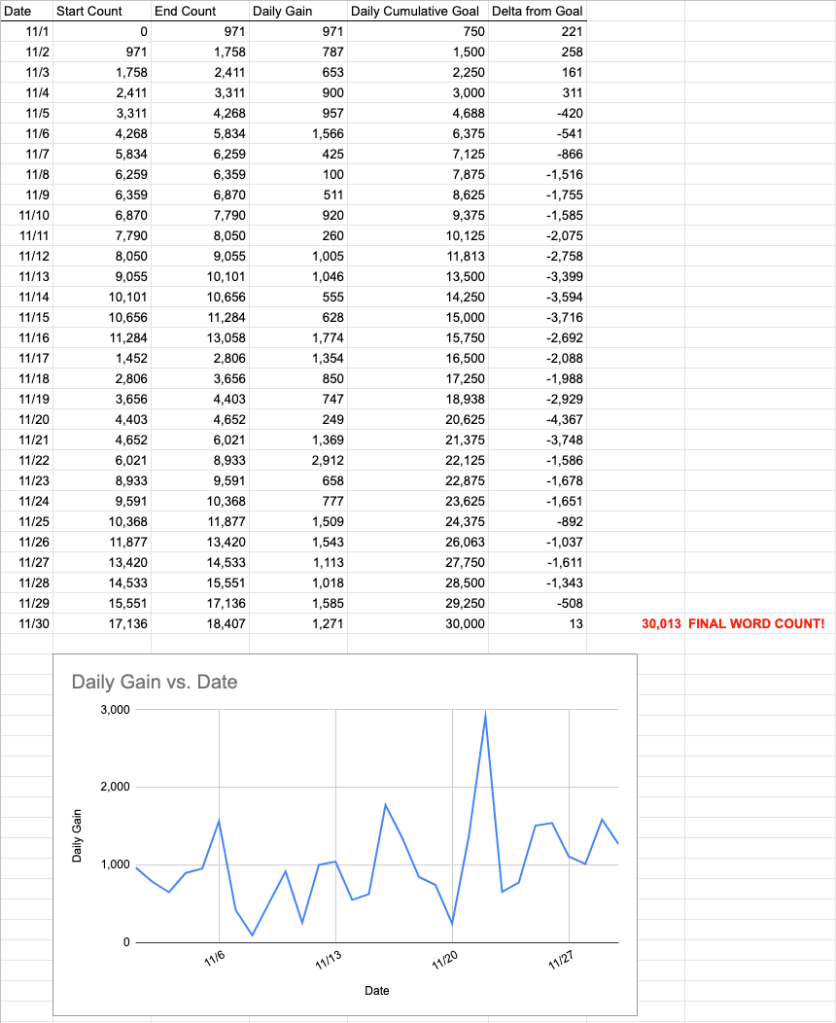
This came from participating in National Novel Writing Month, or NaNoWriMo, last month. The goal is to write at least 50,000 words of a book. I’ve known about the program forever, but this was my first time giving it an earnest try. With a toddler running around, I knew the official goal would be so daunting that I’d get unnerved and give up immediately. I set a personal target of 30,000 instead, figuring 1,000 a day was still a stretch, but doable. After the first week, I started falling behind and already wanted to quit. However, this mantra kept me going, and I proudly finished the month at 30,013.

Screenshot of the spreadsheet where I tracked my daily word counts for NaNoWriMo 2022
My daily word counts for NaNoWriMo 2022. I got sick on the 7th and was ready to surrender when I saw how much I was already lagging behind my goal.

My resolution for 2022 was to write more, and I definitely achieved that. In the first half of the year, I wrote six articles for The Workprint, an entertainment website. I watch a lot of TV, so it felt great to make that time feel productive somehow and have a real platform for my lowly thoughts and opinions.

Then I decided to focus more on creative writing. I discovered and joined a relevant group at work. The founder, a technical writer named Melissa who published her first novel this year, leads frequent chatroom discussions, lunch meetings, and writing sprints to motivate and inspire us. Before this, I’d only taken one writing workshop as an adult, which was a semester-long course at a nearby community college in 2016. This group was therefore only my second time being surrounded by people who were constantly talking about their work and writing. And since this was a work thing, for the first time I was surrounded by people with similar day jobs who were all trying to squeeze in writing on the side. It was a mentality game-changer.

When Melissa created a subgroup for NaNoWriMo and shared links to tips and suggested pre-work, I thought for the first time, I can actually do this. One of these links went to a quiz that suggested the best writing schedule for your personality and lifestyle. My result said to aim for 750 words a day on weekdays (slightly more than one page in the morning, one in the evening) and 1,687.5 on weekends (less than two pages per hour). Broken down this way, hitting 30K seemed almost easy.

She mentioned one day that, often when she’s procrastinating on a work task or tempted to scroll mindlessly through social media, she takes ten or fifteen minutes to add to a creative work in progress, instead. Why not? We all have these little pockets of time everywhere: between reading through that last unread email at 9:17 and the scheduled meeting at 9:30, when one of your back-to-back calls ends ten minutes early, when someone messages you “Hi, quick question” and then doesn’t say anything else for a while. Might as well seize those moments to advance your story’s plot by a few sentences.

Or pedal through a couple songs on the exercise bike. Or go for a walk around the block. Or do some push-ups. You can do so much in ten to fifteen minutes, honestly.

Much of what I wrote during NaNoWriMo ended up being garbage, but it felt so good to flex that part of the brain and just write. I also learned so much about myself as a writer and my creative process. Today, I am cautiously excited to share that I have 10K words of a Real Debut Novel in the works. My resolution for 2023 is to complete it, and enlist some of you as beta readers!

Other highlights from this past year:

  • Read 27 books*! Favorites were Oathbringer by Brandon Sanderson, The Fifth Season by N.K. Jemisin, In the Dream House by Carmen Maria Machado, Tomorrow, and Tomorrow, and Tomorrow by Gabrielle Zevin, Everything I Never Told You by Celeste Ng, We Were Dreamers by Simu Liu, and Born a Crime by Trevor Noah.
  • Got promoted at work
  • Went on our first family vacation with the 3-year-old
  • Attended a bachelorette party
  • Officiated two weddings
  • Played two concerts with our work orchestra, one of which featured some duets with my new cellist friend
  • Did a bunch of outreach to students at NYC public schools about technology careers
  • Started playing the piano again
  • Got a 15-year-old cyst removed

*You may be wondering, how on earth did I find the time to read so much? Lots of audiobooks, lots of ten- to fifteen-minute bursts. 😉 Mostly while doing chores, walking outside, and driving.

For the first time in years, I feel most of the time that I have a pretty good balance in life. I’m focused on and confident about clear, specific missions. There have certainly been lowlights, as well, but I’m getting more resilient and dealing better with things.

Here’s to ever more growth and confidence in 2023.

33

So far, I’m actually feeling great about 33.

This time last year, I was on the express train to burnout. We had pulled our child back out of daycare, fearing the spike in COVID cases over the holidays. We were taking turns parenting an active almost-two-year-old while I was putting in 10- to 12-hour work days. I was also planning all our meals, ordering weekly grocery deliveries, cooking, doing laundry, and trying to keep our house minimally clean.

I had hefty deliverables at work with ambitious deadlines. Roughly 200 hours went to offloading a major responsibility that our team had outgrown and come to dread. I spent another 200 or more developing materials for a top corporate priority in 2022. I also influenced a busy, important team to contribute to foundational work that has since been used for dozens of spin-off projects—notably, succeeding where another group had failed twice before. All with no material help from anyone else in my department.

In the end, incredibly, I pulled it all off.

And nobody cared.

My manager—with whom I’d always had a great relationship, who saw and appreciated my work without micromanaging, who promoted me while I was on maternity leave—left the company. His replacement didn’t understand my unique role. I had prepared a summary of achievements and metrics, but he didn’t even spare it a glance. He didn’t want to talk about the path to my next promotion or making me a manager, something I’d been asking about for almost two years. In fact, he actively discouraged me from these goals. So I left the team. Then two white men were promoted internally to management, and a third and fourth were hired externally.

There’s more to this story (and I’m all too happy to share), but I don’t want to spend the bulk of this post griping about the past.

In February, as I finalized the move to a new team, I reflected on two lessons learned:

  1. Trying to be a hero isn’t worth it.
  2. Trying to change someone else’s perception of what a leader looks like isn’t worth it, either.

I realized how laughable it was that I had pushed myself so hard at work for this kind of leadership team. I genuinely thought I was earning a promotion, or at least a 5 out of 5 rating in my semiannual employee evaluation. I had gotten a 4 out of 5 the previous evaluation, and this time around I worked much harder for more impressive achievements—so a higher rating seemed logical, even inevitable. Yes, I was delusional.

I happened upon an internal memo explaining various corporate structures and how ours is a slime mold. Sounds unglamorous, but it explained how slime molds can be very intelligent and useful. For example, if you arrange food in the same layout as Japanese cities around Tokyo, a slime mold will grow in the same pattern as Japan’s rail system. With this kind of culture (pun intended), heroics are almost always futile.

It also outlined, like game theory, the risks of juggling multiple concurrent projects and strategies to maximize their success. The main takeaway was that everyone needs to say what they’ll do and do what they said. I thought this was so profound, even though it’s basically a schoolyard adage in the same class as “do unto others as you would have them do unto you.” It wasn’t a novel concept, but given everything else going on in my life at the time, it suddenly made the pieces click together in a meaningful way.

It was applicable to social interactions and relationships outside of work. How often have I tried super hard to be there for someone, only for my efforts to go unreciprocated? Or how often have I failed to help or support a friend? I’m not suggesting that every potential action should be weighed against a ledger of past transactions. Instead, I should assess more thoughtfully whether something is truly going to be appreciated, whether someone truly appreciates my time and me. I understand it isn’t always personal. We all have different social circles and obligations. As with different cross-functional projects at work, we need to communicate and commit at whatever levels are appropriate for our relationships to thrive. And if someone is locked into a certain perception of me, there’s only so far I’m willing to go to change it.

The takeaway was fitting for the battle against viral outbreaks and the COVID-19 pandemic, too. Why have some of us been trying so hard to be responsible with sheltering in place, wearing masks, getting vaccinated, and so on, only for others to scoff at the virus and bring it to endemicity? It’s hard not to feel frustrated or bitter about having done our individual parts and still failed as a collective. Yet this scenario is dissimilar, since the spread vs. eradication of COVID isn’t the only indicator of failure vs. success. As long as my family and I are alive and healthy, we are succeeding—and grateful. Our efforts here aren’t in vain.

With each passing year, I get better at setting and focusing on goals and priorities for my life. This past year in particular, I’ve given more thought to other people around me, what their priorities might be, and whether it’s worth attempting to engage them. It feels weird writing it out this way, but I honestly feel I still have so much to learn (or re-learn?) about being social. It is helpful to approach or frame it as I would a work situation.

In and out of work, I’ve become deeply thankful for frankness, earnestness, and dependability. This is a big deal because I was raised only to value intelligence, and only a narrow definition of it. It’s taken conscious (un)learning to appreciate other types of intelligence and traits such as kindness. This has given me a sort of clarity that makes me more content with my life now than I’ve ever been.

Of course, there’s more to the contentment that I’m feeling these days. Work is much less stressful, yet feels more impactful. Our toddler is such a delight; he is mostly cheery and agreeable, loves to clean and help, is cute and funny, is willing to explore new things, and shows me new ways to view the world around us. I joined a book club at work and have gotten into audiobooks, “reading” all the time while doing chores, going for walks, and driving around. And I think I’m finally ready to start writing more regularly again, which is exciting. For once, not only am I at peace, but I am also optimistic that we can make it last.

Beach Day

Today, I had the best day with my kid.

We went to a beach I’d never visited before. When we arrived at 9:15 am, I was pleasantly surprised to find only two other parties as far as the eye could see. It felt as if we had the place to ourselves. It was sunny and hot. Supposedly the day’s high would go up to 97 degrees, but by the ocean, it felt perfectly comfortable.

As I placed our belongings on the sand and got my bearings, my kid ran to the shoreline. He lost his balance in the retreating tide and fell flat on his butt in his everyday clothes. It was a cute, comical sight.

I changed him into beach clothes, and then we dug into the sand with his little plastic shovels and made shapes with his molds. We walked up and down the shoreline and counted jellyfish. He chased seagulls and shouted, “Hey, come back!” when they flew away. We floated his toy boat into the sea and clapped as the tide pushed it back into his hands. He tried to sit in the water several times, but jumped to his feet and ran away as soon as the cold swept in. He found two flawless seashells with the same nonchalant luck behind a four-leaf clover a couple weeks ago. Every so often, he would grin or giggle at nothing but the wonder of being at the beach. My heart swelled with love for this sunny, inquisitive, sweet, adorable little toddler who was all mine. And like this, two hours flew by.

There was a small amusement park next to the beach. He’d noticed and marveled at the “big playground” during the drive, so he was excited when I suggested heading over there to take a look. He expressed interest in a ride that featured a dozen green and yellow cars going around in a circle. I paid a dollar and took hilarious photos and videos of him looking bored and disdainful on the ride. Next, he pointed at the purple “train tracks” of a roller coaster. We sat together; I whooped and laughed while he sat in bewildered silence. When it was over, he exclaimed, “Fun train tracks!” It was so cute that the park attendant chuckled, too.

We went home and ate lunch. After reading some books together, he played quietly with his miniature cars until he fell asleep right there in the living room.

Today, I had the day off from work. My original plan was to send my kid to daycare and have time to myself at home, maybe make up some work I’d meant to complete last week. Then I thought about how my husband and I had dragged him to hang out with our friends every day of the long weekend. We hadn’t had much time for just our family. We have plans the next few weekends, too. When would be the next time we could go to the beach? Wouldn’t it be crowded during the weekend, anyway? And he is growing up so quickly. How much older would he be “next time”?

I’m so happy I got to take the little guy out on an adventure. (Almost) two and a half years is such a fun age. I want to remember how today felt for the rest of my life. I hope he made some happy core memories today, too.

Questioning

At this point, I have to wonder if I am the problem.

That’s what they say, isn’t it? “If you’re having problems with everyone around you, then you are the problem.”

I’ve talked about having spent a non-trivial amount of time trying to hold constructive dialogue with people of various backgrounds and world views. It was depressingly, mind-numbingly futile. Most people were too cemented in their opinions and beliefs, even when presented with sound logical arguments and contradictory evidence. I have long prided myself on being an objective thinker, clear communicator, and open-minded person. It never got us anywhere.

This past Wednesday, the day rioters stormed the U.S. Capitol, I had yet another bitterly disappointing exchange. But it wasn’t with an Internet stranger; it was with someone who was supposed to be a friend.

He stated that the people storming the U.S. Capitol shouldn’t be considered extremists—they were “everyday Americans.” His reasoning:

  1. Many more people would have participated if they had the means. Therefore, this should be considered an ordinary, “everyday” act.
  2. x% of Americans would break into the Capitol if they could. Asian-Americans also make up x% of the American population. Asian-Americans should be considered everyday Americans. Therefore, the people who would break into the Capitol should also be considered everyday Americans.

My counters:

  1. Thinking about or wanting to do something is irrelevant. The ordinariness of an act should instead be measured by the number of people who actually commit it.
    Regardless, extremism is not defined by whether an act is committed by few or many people. We should consider only the nature of the act itself.
  2. This is a false equivalence.

He terminated the conversation abruptly by calling it a “waste of time,” “pointless,” and “dumb AF” because “the other side isn’t even willing to listen.” Oh, and apparently, his core point all along was that President-Elect Biden wasn’t doing enough to address systemic issues.

For the next 24 hours, I was pretty damn angry. Where did this come from? Throughout the discussion, he never once said anything like “That’s not what I’m saying” or “You’re missing the point.” He didn’t counter any of my counters. Most frustrating of all, he moved the goalpost. You know from my linked post that I am all too aware of the systemic issues. But he never expressed that point until the very end.

That leads me to two possible conclusions:

  1. He is not a logical thinker or debater.
  2. I wasn’t as flawlessly clear and logical as I thought.

My gut reaction was to take door number one. I mean, even now, writing it out and rereading it, part of me still believes it. How does any of his reasoning make sense?

Yet by now, I can no longer deny the well established pattern. I always walk away feeling disgruntled that the other person didn’t do their part to meet me halfway in logical arguments and empathy. I’m always the one believing the other side to be dense and stubborn. Now I even have this sentiment toward someone I’ve known for a decade, who is well educated and has a successful career? Am I just the cleverest person in the world? No fucking way.

The anger is gone. Now I’m simply sad and confused.

I’m starting to realize that I might place too much importance on holding dialogues a specific way. One ought to clarify and solidify each point before moving on to the next. If there is any ambiguity or misinterpretation, it is essential to correct that straight away. If one agrees with some parts of an argument but disagrees with others, one ought to lay out both the agreements and the disagreements. I call out logical fallacies when I see them, because otherwise my brain gets stuck. Is that just how my mind works, or is that snobby intellectual gatekeeping? Do my unspoken “rules” facilitate clarity, or do they only make me seem as though I care more about being “right” than actually learning?

If this is just how my mind works, maybe it’s not well suited to discuss social or political ideas with others at all? That doesn’t make sense to me. In my opinion, everyone could benefit from trying to be as logical as possible. But maybe I am not logical enough to see my own lack of logic? Like Heller’s Appleby, I can’t see the flies in my eyes because of the flies in my eyes?

Either way—whichever conclusion is correct—it appears I lost a friend that day. As bewildered as I was by his fallacies, I was genuinely trying to understand his thought process. If he was over it, he could have at least been respectful enough to say, “That’s not it, but I don’t have time to get any deeper into this right now,” “We’ll just have to agree to disagree,” or even a succinct “Never mind.” Instead, he chose to be insulting, and he isn’t taking it back.

Is it telling that, once again, I’m fixating on communication style and verbiage? Or is he in fact a jerk, one I’m better off no longer keeping in my life?

I don’t know how to think anymore.

2020 Year-end Reflections

Well, here we are in 2021.

I know I’m not the only one to say that 2020 was soul-crushing. I also know I am extraordinarily privileged in some ways. Many, many people have had it far worse.

Nevertheless, it hasn’t been easy watching a toddler while working from home full-time. For most of the 4.5 months that we’ve had to keep him home from daycare, I have been working until midnight or later to make up the hours spent on childcare during the day. I was in a new, higher-visibility role at a new organization*, and my to-do list felt never-ending. When my kid takes a nap, my first impulse is (still, even during this long weekend) to head straight to my computer to do more work.

*I didn’t even get a quiet ramp period at a brand-new organization. My company was acquired, which meant we had to do our regular work plus figure out a bunch of changes. New business applications, integrations and migrations, where to look up details on our new paychecks and health plans, whom to contact with questions about expense reports, etc. etc. All while not being able to turn to a friendly office neighbor to ask a quick question face-to-face.

“I can’t wait until 2020 is over” is a sentiment I’ve heard echoed all around me. I get it—but in a literal, calendar-year sense, I really don’t want 2021 to begin. Not when the COVID cases are still rampant and we continue to feel our kid’s health could be at risk in daycare. The end of December meant a corporate slowdown when most people were out of office, almost no one was pinging me, and I was actually able to get larger chunks of thoughtful work done. The start of January means things will kick into high gear again, I’ll be back to working late nights, and I won’t be able to hang out with my husband… or anyone. At least, not much.

Here’s a fun game I’ll be playing by myself! Which will happen first: our state will go back to having fewer than 2,000 new cases of COVID per day, or I’ll collapse from stress and exhaustion?

It’s stupefying how the days blur together when all you do is entertain a toddler, work at a computer, and get six hours of sleep. I keep wanting to do some basic things every day, like eat multivitamins and do push-ups. Not being too hard on myself, right? Next thing I know, four days have gone by and I haven’t done any of it.

I missed my annual birthday/Thanksgiving tradition of sharing my reflections on the past year and hopes for the next. It makes me sad that I haven’t had time to write anything until now, more than a month later. My last post was over four months ago. Just as my body feels soft from infrequent exercise, the creative part of my brain feels soft from never writing anymore.

This might be crazy, but I think what I ultimately need to feel better about myself and this whole awful pandemic is more things on my to-do list. When Will Smith was preparing for his role in I Am Legend, he interviewed prisoners and learned that a fixed schedule was the key to surviving solitary confinement. I’m going to try sticking to specific times to take vitamins, do push-ups, and even try to write a little every single day. Maybe you’ll be hearing more from me here.

Here’s to the new year.

On the Edge of the Yawning Crevice

In 2016, the day after the U.S. presidential election, I wrote an essay criticizing social media echo chambers. I stated that anyone who was flabbergasted by Trump’s victory was part of the problem. I urged people to break out of their echo chambers, seek alternative perspectives, and hold constructive dialogues with their fellow community members. We’re all in this together, I thought. We can fix this.

Boy, was I naive.

To do my part, I joined a number of Facebook groups for area residents. I subscribed to new subreddits. After having a baby in 2019, I also joined a moms’ group on Facebook whose About page mentioned, “Various vaccine schedules [including no vax] will be popular here.” I tried really, really hard to talk to people. I mulled over their messages, asked honest questions, suppressed my natural sarcastic tendencies (at least until it became clear that nothing productive could come out of a conversation), and sought a modicum of mutual understanding. I worded every sentence carefully and made sure to include courteous, rapport-building phrases like, “Perhaps I am misreading, but…” and “I do agree with you that…”.

It was a waste of time and energy about 80% of the time. These people had made up their minds long before logging into Facebook, and no number of thoughtful questions or amount of personal sharing from an online stranger was going to change them. It made no difference that this online stranger was supposed to be a friendly neighbor, someone they might encounter at the local park or grocery store. Only a handful were civil. Most defaulted to calling me a “triggered snowflake,” even when I hadn’t stated any liberal points. Only a few were capable of logical reasoning—and not all of them overlapped with the civil ones. One or two must have been Russian trolls, with a handful of friends and an image of the American flag as their profile picture.

While I learned a lot about different people’s worldviews and motivations (which I am counting as 15% of the time not wasted), I doubt they absorbed much of mine. They simply did not care. They were only there to mouth off about their opinions and fears, not to learn anything that could risk changing them. The remaining 5%, I might have persuaded someone to acknowledge or reflect on a concept. Never got definitive proof, though. For all I know, they reverted straight to their old mindset as soon as I locked my phone and returned to the real world. I didn’t even make any new friends along the way, which might have been a decent consolation prize.

The crux of the issue is that we, as a society, no longer strive to establish common ground with each other. The COVID-19 quarantine may be partially responsible for aggravating our moral decay, as we have lost significant face-to-face contact and grown increasingly indifferent to words on screens. However, this was already a problem in 2016 when I wrote that essay. It was probably even happening years before that, as the advent of social media drew more people online. We are letting the media, mainstream or otherwise, manipulate us into senseless infighting and believing that the “other” is a crude, absurd caricature. We are too caught up in the fog of buzzwords and propaganda to see real people as they are. When we see a particular something in a profile picture or comment, we instantly throw that name into a bucket with some stereotypes and start going “lalala” with fingers in our ears.

This isn’t just about right-wingers. The left is guilty of this, too.

So many topics should not be political, yet people are determined to politicize them. We cannot even wear face masks without being associated with socialism and “men in women’s bathrooms.” Basic science and facts are no longer trusted. People formulate deep-seated opinions without any academic knowledge or extensive personal experience. They hate people for doing something or coming from somewhere, without reflecting on possible motivations or—I don’t know—asking them about it. Blatant hypocrisy and discrepancies in belief systems are ignored. Context, nuance, and empathy have all gone down the drain. Nobody can answer a basic fucking question anymore without “but what about…”s, straw man fallacies, beating around the bush, and name-calling befitting of an elementary schooler.

Take “Black lives matter,” for example. Do you agree that they do?

No, don’t start about the protests and the looting. I’m not talking about the movement, the organization, or whatever “independent news” article you read the other day. Don’t tell me about your family member who is an upstanding police officer or how much Black people attack their own. We can work our way to that, eventually. If you’re willing to keep hashing this out with me. First, let’s take about twenty steps back and just consider those three simple words.

Do you agree that Black people have worth?

Are they as equally entitled as white people to Life, Liberty and the pursuit of Happiness?

Unless you are a sociopath or happily admit to being an asshole, it shouldn’t be that hard to say it out loud with me. Black lives matter.

That’s where we need to start, from square one. It seems so simple to me. Yet I haven’t been able to get any #MAGA2020 proponents in my various Facebook groups just to say those three words by themselves. At best, I have seen a few people insist, “Black and blue lives matter.” It is pathetic, worrying, frustrating, infuriating, and depressing. They claim to want this country to come together, but when I throw the ball in their court, they ignore it or toss it away. The same goes for just about everything else: the pandemic, reproductive rights, healthcare, LGBTQ rights, education, climate change, and so on. It should be easy to agree on some core tenet—but for some utterly baffling reason, we can’t. All these keyboard warriors lack logical reasoning, empathy, or both.

Last weekend, I was teased by a glimmer of hope when someone named Michael posted in our township’s group about the need for people to work together through disagreements. Someone else who gets it! I thought. Actually, his original post was a quote from an alleged military veteran threatening that if “you people” didn’t “work it out,” they would “make your lives hell because war is hell.” I asked for clarification on the purpose of posting such a quote. Michael politely claimed it was a rallying cry for compassion and solidarity. Hm? Not the most logical interpretation, but I wanted to support it—so I replied, “Got it, thanks and I agree.” He then responded with, “Talk about poor reading comprehension.” Are you serious? Why would you turn around and make a remark like that, when I had given you the benefit of the doubt and left your stupid trigger-happy quote alone? When I told him that was rude and unnecessary, he dug his heels in like a petulant child and called me a snowflake. Maybe Michael is just a cretin, but sadly enough, he is far from an anomaly. There are many like him, who love being illogical and crass. They even have allies who defend their assholery. And all of them will mock you for being a “snowflake” when you call them out.

One election cycle later, I believe the echo chambers have gotten worse, not better. Not only are people feeding into biased content with more voracity and determination than ever, but they also double down on it when anyone else dares to suggest something non-conforming. I saw a post just yesterday by someone who claimed, “Democrats want to abolish the local police.” Three people commented that they were Democrats who did not, in fact, want to abolish the local police. Two others commented later along the lines of, “Yes, it’s unbelievable. What is wrong with them?” I was dumbfounded. Here were three people speaking up to correct a misconception, yet their messages were displayed to blind eyes. Lord help us.

What was a hairline crack in the foundation of our society has become a yawning crevice.

If things continue like this, Trump will win again in 2020—though that is not even my biggest concern. If so many individuals truly feel Trump is their champion, and not enough others care enough to de-throne him, then I will accept that he is the president our nation deserves. Instead, I am worried about how American society will continue to devolve beyond the next presidential term. I am also worried about things like deepfakes. We are already rejecting science and facts with little to no justification. We are already falling for obvious and easily discredited propaganda, like the birther movement and the video about Planned Parenthood’s operations. How stable of a civilization can we expect to have when there is—perhaps very soon—substantial justification for rejecting all information?

I found out from my mother one day about anti-Black discourse taking place among a network of Chinese-American immigrants on WeChat. I told her this was wrong. I explained systemic oppression to her and why we, as fellow non-whites, need to care. Even though we don’t have the closest relationship and we never talk about this stuff, she was receptive. She told me later that she looked further into one of the media personalities discussed in the group and realized how foolish that person was. So I would be happy to keep having these conversations with people I know and respect. With all these other randoms, though, I am done. At last, I am accepting that this is something I cannot fix, that this is a heap of non-biodegradable garbage in which I cannot even hope to make an appreciable dent.

Our only hope is that people like Michael have family and friends who are more reasonable, with whom they will engage more respectfully. If you have zealously antagonistic relatives, you need to do your part in changing them. We all know at least one person who is in a group chat where problematic videos and memes circulate. There may be that one relative who is cooped up all alone in their house and falling into a rabbit hole of toxic YouTube videos for hours every day, the algorithm relentlessly digging them deeper and deeper. If you want to make a difference, you need to sort out your own racist grandparents, your misogynistic Uncle Mike, your crazy Aunt Karen, and that one weird kid from high school who never left your hometown. I can’t reach your people. I have tried so much that my head is weary and my heart is heavy. Those people won’t listen to an online stranger like me. Someone has to get through to them, though. Human beings need to build more empathy toward each other if we wish to survive in the long run. We are fast approaching a point of no return. When deepfakes and other conspiracies inevitably threaten to tear apart our communities and livelihoods, we will need to care enough about each other to investigate matters and determine the truth. Otherwise, we will be doomed to paranoia, chaos, and obsoletion.