I Don’t Think I Actually Like Writing

I left the corporate world four months ago. Now, theoretically, after cooking and cleaning and managing my two young children’s school events and appointments and all the other domestic necessities for a family of four, I have six hours a day to focus on my dream: becoming a published author.

What I have found instead is that this thing I’ve been chasing for over thirty years is not only harder than I thought it would be, but also innately changed from what it used to be. The revelation feels like a mid-life crisis.

I thought I knew what I was getting into. We have all heard about J.K. Rowling getting “loads” of rejections before finally getting Harry Potter published. I had done research on the industry and various publishing paths. I walked away so inspired from AWP25 (a major writing conference) and local writers’ events.

I think the first crack that appeared in this beautiful, shiny vision was when I lost a cute pencil case holding my favorite Japanese rollerball pens within the first hour at AWP25. I checked with the lost-and-found counter and building security several times throughout the multi-day event, refusing to believe that “my” community would simply throw it away—or worse, keep the pencil case for themselves.

Then the rejections continued pouring in. I’d already been querying literary agents to no avail before AWP25, but the ones that came in after hit harder.

Previously, I was submitting a novel about a first-generation immigrant trying to play the right political games to climb the ladder at tech companies. Two agents read the full manuscript and told me gently that while my writing was solid, the story wasn’t all that interesting. Looking back with a more critical eye, I could see what they meant. My book was, in fact, a memoir masquerading as fiction. There was much I’d envisioned but failed to execute.

This time around, I was submitting a medical memoir I’d written after nearly dying of sepsis at age thirty-five and being hospitalized for four weeks. It was way more personal, which meant the rejections felt more personal, too. My brain knew that these agents and publishers likely did not feel up to the task of representing my book. The industry probably isn’t interested in personal pain and suffering at a time when everyone is suffering and looking to escape from pain; it’s also very, very hard to get readers to care about a memoir by someone who isn’t famous. But my heart felt that no one cared about my life or this nightmare I’d survived. There hadn’t been so much as a paragraph in the local newspaper about my experience. I was told I didn’t have a case for a medical malpractice suit. The State Board of Medical Examiners didn’t think my OB/GYN was at fault in any way for being dismissive of my postpartum fever and pains. And now, no one wanted to help get my 70,000-word book out into the world.

On top of that, I was actively applying to jobs. For four months, I was receiving simultaneous rejections from agents, independent presses, and potential employers. Each response or lack thereof reinforced the message that I suck at writing, work, and life overall.

You need thicker skin, you’re thinking. On good days, I agree. On good days, I have ideas and stories trying to fight their way out of me. I tell myself I can work on the next manuscript while waiting to hear back from publishers on this one. I know it takes time and effort to build up a fanbase and a writer community, and I still have this vestigial mindset from a “gifted” childhood where I expect things to come easily without working for them. That I’m still open to self-publishing, which would enable me to spread awareness of sepsis. That spreading awareness, potentially saving someone from suffering the same fate, is still my top priority for this book.

Ugh, but we writers also want other people to think we’re good at this, don’t we? I also want readers to find my words insightful and inspirational. I want them to go, Wow, I’ve never thought about it that way or That’s interesting information or That strikes a chord, even if it’s just over one sentence out of thousands. I want them to feel invested in my experience and wellbeing.

On bad days, which composed most of this month, I don’t think I’m particularly good at this. I write painfully slowly and spend more time procrastinating than actually doing it. I don’t know when to elaborate on a point and when I am being heavy-handed. I don’t want to be in a community of writers. I am not even half as literary, imaginative, or epic as the authors I admire most. My style is best described as “everyday, with the occasional funny or poetic turn of phrase.” And I am finally coming to accept that that may not be enough.

ChatGPT was the final nail in the coffin for me. I’m so dismayed by the flood of AI slop washing over LinkedIn, Reddit, Facebook, and Instagram. The other day, someone made a very obviously ChatGPT-generated Facebook post promoting a household product to a group of over 40,000 moms. Several members gushed over the “amazing writing style.” Even though a few others replied to point out that this was generative AI, it wasn’t enough to un-break my heart. I think about those studies showing that the average person not only struggles to differentiate between poetry written by humans vs. AI, but even prefers the latter—and I wonder, What’s the point?

When I read The Catcher in the Rye in middle school, I took to heart that notion about how a good book makes you feel as though you could be friends with the author. I believed that if I wrote in a straightforward, accessible manner, people would naturally gravitate to my work. It didn’t happen with my novel, it hasn’t happened with any of the short stories or essays I’ve submitted to online magazines, and it isn’t happening here on Substack. At this point, I don’t even know if I am capable of good writing or why I wanted to be a writer. Maybe what I truly want is respect and admiration from others, and writing was merely my vehicle of choice to procure it.

Every morning once my kids are out of the house, I should be excited to work on a draft—but I’m not. Instead, I just want to play music. Maybe this means the stories in me aren’t meant to be told through books. I’m now exploring alternative paths for sharing them, including but not limited to songwriting. I know everything is hard, takes real work and commitment, and can be tainted by AI. Additionally, a worry lurks in the back of my mind that once I reach a certain level of skill or achievement in another area, I’ll be disillusioned again and come to the same conclusion as I have with writing. But I have to try. I want to believe that I have a calling.

Retirement, Week 7

I had lunch a couple weeks ago with a friend who quit her corporate job last year. When she asked how retirement was going for me, I said I couldn’t believe I used to work eight hours a day and feel I still had enough time left to chip away at my hobbies. Now, the activities I used to cram into the hours of 8:30–10:30 pm seem to take up all day.

“The days just fly by,” she agreed emphatically.

I’m definitely less laser-focused. The world is now truly my oyster, and that means I sometimes have trouble prioritizing personal projects. When I was working, I had to “prioritize ruthlessly,” as I often said in my day job as a product manager. I only had one or two hours a day to write, so I made sure to write. However, as any author will tell you, consistency is key. Neil Gaiman famously tweeted, “I wrote Coraline at 50 words a night.” I’m proud to say that my own discipline enabled me to complete two full book manuscripts in three years.

Writing is still my top priority, or should be. I’m still working on publishing my memoir of surviving sepsis at age thirty-five. I recently got an exciting response from a small, independent press: they’re interested, but would like to see some edits. They even told me exactly what to add, and I agree that it matches my vision for the book and would make it better. With such a clear path forward, I should be working on it six hours a day and wrapping up ASAP! I should be turning in a revised version next week!

But of course, it’s not that easy. I need to dig deeper into this traumatic episode of my past and conduct more research. I think I’m also procrastinating because part of me is afraid that, after making the suggested edits, it still won’t be enough. I’ll get rejected again, and I’ll feel hopeless about such an important story ever seeing the light of day.

There’s other stuff I want to do, too. I would love to build an audience on Substack (where, for now, I’m duplicating the blog posts you find here on WordPress, to see which platform performs better). I see so many notes on my feed from random strangers saying, “I used to get zero views on my posts, but now I have a bunch of subscribers! Keep trying; it can happen to you, too!” I built a DIY harp and have been taking lessons and daydreaming of becoming the next Joanna Newsom. I am reading more, and more critically, as “research” to refine my vision for my first novel. And next month, I will be rejoining rehearsals with the professional symphonic band with which I freelanced from 2012 to 2018. Oh yeah, and I still have two young children to parent.

I’m feeling a lot better about the way I left my last job, though I’m dissatisfied with how gentle I went in the night. Sometimes I think I ought to write a LinkedIn post about retiring, something sharp yet sentimental about my career path and influential players—good and bad—and the tech industry as a whole. But each week that goes by is like another hour at a party where you’ve just met someone and already forgotten their name: the longer you wait to bring it up, the more awkward it feels. After the career I’ve had, I deserve more. I crave attention, validation, vindication, lamentation. I want to see comments from past colleagues and clients about the impact I’ve made on their lives, how amazing and inspiring they find me, and what a shame it is that we’ve lost another woman in STEM.

It occurs to me as I write this that I could still post on LinkedIn once I “achieve” something in retirement. For instance, if I secure a publishing deal for my memoir, I could share that and reminisce about my tech career. Yes, that would do nicely…
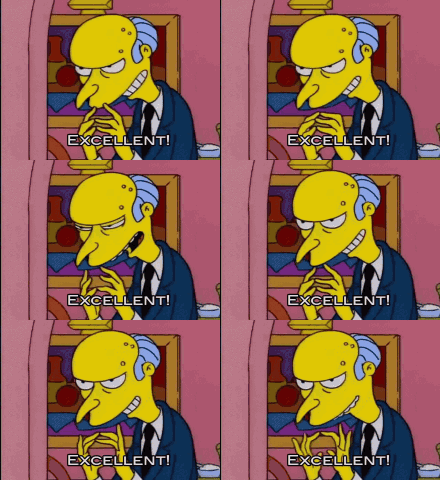
I’ve just unlocked a new level of motivation to make those edits. Back to the manuscript!

My First AWP

I was just in Los Angeles for AWP25, a three-day conference and book fair by the Association of Writers & Writing Programs. Over ten thousand writers—published and unpublished—publishers, editors, literary agents, educators, and more gathered for sessions, readings, and networking.

Before the Conference

Mindset

I have a completed manuscript, which means I have a draft of a book that I am ready to show others in hopes of getting it published. It is a 60,000-word memoir about surviving postpartum sepsis at the age of thirty-five. At the hospital, the doctors found me to be at such a late stage of the disease that my heart, lungs, kidneys, and other organs were failing. I essentially had a heart attack and much more. If I hadn’t taken myself to the emergency room that day, I would have passed in my sleep that night.

I have another manuscript from 2023, an 83,000-word corporate dramedy intended as a mix of Silicon Valley, Severance, and Demon Copperhead (actually more like Lazarillo de Tormes, but no one knows what that is unless they’ve studied Spanish literature). I sent it out to a few agents, but received the same feedback from both who’d read the full: “It didn’t grip me the way I thought it would.” After some reflection, I still believed in the concept but had to admit the execution was wanting. This manuscript, which I previously thought was complete, will need dramatic revisions.

Hence, I went into AWP25 with two goals:

  1. For my memoir, learn about the industry: Do I really need an agent? What are the possible publishing paths? What should I be thinking about to get my book into as many readers’ hands as possible?
  2. For my novel, attend sessions on craft: How can I refine the scenes and plot?

Networking was a sub-goal for both. In Big Tech, you could think of it as a KR (key result) for my O (objective). Obviously, you could find articles, discussions, and workshops online to answer the questions above. I wanted to hear from real people what did and didn’t work for them.

Logistics

The very day I signed up for Substack, I saw Courtney Maum’s My Top Tips for AWP Los Angeles 2025. I knew the author from her book Before and After the Book Deal, which was how I’d learned of AWP in the first place. Kismet. The post was extremely helpful, and I patted myself on the back for the excellent decision to join this platform.

During the Conference

Sessions

The main conference and book fair ran from 9 a.m. to 5 p.m. PDT on Thursday, Friday, and Saturday. Sessions were 75 minutes long, with 20 minutes in between. Since I wanted to learn as much as possible, I vowed to attend one in every time slot, which meant a total of 15 talks and over 18 hours of listening time.

All of them were wonderful! With over two dozen options in each slot, it was often hard to pick one, but I was very happy with my selections. My top five, in chronological order:

  • The Art of the Uncanny: This was about effectively employing surrealism, speculative elements, and black comedy. I want my corporate dramedy to be more absurd and scathingly satirical, so this was highly relevant. The panelists read from their works, which all sounded so intriguing, and shared great tips.
    • The session was so packed that all 200+ seats were filled and people were up and down the aisles. Was this a sign of the times—that dystopian works like The Handmaid’s Tale and Black Mirror are hitting harder than ever—or were these authors super famous? (I felt bad, like an imposter, for not knowing most of the presenters at AWP25.)
  • Publishing Paths 101: Big Five, Indie, Hybrid, or DIY?: The panelists answered all my burning questions, and ones that hadn’t occurred to me. Now that I’m back at home, I’m excited to do more research and hone in on the right path for my memoir!
  • Beyond Large PR Budgets: Launching a Book & Reaching Your Readers: Another eye-opening talk for industry newbies. The best takeaway for me was that there’s a lot I can apply from my day job as a product manager to writing and launching a book. I already understood the importance of knowing my audience, but we should also consider the definition of success, evangelism, and product marketing.
  • Becoming a Debut Novelist: The Journey from Agent Queries to Book Launch: The title says it all. This session reinforced the epiphany I had about product vision and strategy for books.
  • Conflict: Hell is Story Friendly; Put Your Protagonist Among the Damned: I almost didn’t go to this one because it was at the same time as “I’ll Tell You What I Want, What I Really, Really Want: Agents Explain Manuscript Wishlists.” However, after attending two discussions the day before that were by and about agents, and one earlier that morning about networking in a productive and genuine way, I was in the mood for a craft panel. Good thing, because these panelists were brimming with insights and humor!

I walked away so, so inspired every day to keep hacking away at this writing thing.

Aside: I hate how you can’t use bullet points anymore without your text looking as if it came from ChatGPT.

After Hours

After 5 p.m., there were many “off-site” events each day. Because I didn’t know anyone or what to expect, I was wary of spending money on cabs to the farther venues. Still, I managed to have a pretty good time.

On Thursday, I treated myself to a fantastic solo sushi dinner at SUGARFISH by Sushi Nozawa, right next to my hotel. Then I headed back to the conference center for the keynote presentation by the legendary Roxane Gay.

On Friday, I went to a nearby brewery for a happy hour hosted by Atmosphere Press. This was my favorite off-site because I actually got to chat with fellow writers, which was not easy to do from 9 to 5 with everyone dashing from one session to the next. I sat at a table with seven others and it was just a very warm, supportive, engaging environment.

It was so fun, I almost regret leaving after one hour for a poetry reading organized by a university press. As an alumna of that university, I wanted to discuss publishing my memoir with them. Turns out they are only printing poetry these days, but at least I enjoyed the reading. It motivated me to make my writing style, eroded to bare bones by so many years of corporate-speak, more literary again.

On Saturday, I attended another poetry reading at a bar. Before it began, I had a great conversation with an editor of a literary review who is also a poet and a writing coach. I signed up for a free poetry workshop that she will be running soon. Maybe I’ll start posting poetry? I’ll think about whether that aligns with my product strategy. 😉

Final Thoughts

AWP25 exceeded my expectations. I achieved my goals for the conference and had an amazing time! I don’t know yet if I’ll be making a habit of it, but I would say it is worth it for aspiring authors to experience at least once. My only regret was losing my pencil case within the first hour.

2023 Year-end Reflections

Wow, my first and only blog post this year. I want to say I’ll make a renewed effort to write here more often next year, but I already know I won’t.

That’s not to say I haven’t been writing, or won’t be in the near future. This year, I wrote more than ever. I wrote an entire novel! It is 81,000 words long, 265 pages of a double-spaced Word document. I started it last November during NaNoWriMo and finished it last month. Next, I’ll be dedicating major time and energy to revisions.

Part of me still can’t believe I did it. Writing a book has been a dream, a bucket-list item, for most of my life. I remember starting my first story, which had something to do with a magic academy, on a Windows 95 computer. I got up to maybe 10 pages at most, before losing creative steam and moving on to other elementary-school pursuits. There are countless other abandoned attempts floating around, opening sentences and paragraphs leading nowhere in my mind, in various notebooks, in the cloud, and probably in broken hard drives in landfills somewhere. But I finally pulled together the ideas and focus to get this body of work done, and for that, I am really proud of myself.

The other big highlight of the year was getting pregnant with our second child. This, too, has been a journey. We started saying three years ago that it might be nice to add to our family. Tiring and stressful days, bad timing, probable fertility challenges, and a miscarriage made it take longer than expected. I don’t mind the bigger age gap, though. With both of us working full-time, I’m happy that our firstborn will be more mature and independent. The three of us are very much looking forward to embracing our new family member soon.

We took four family vacations: to the Poconos, the Bay Area, Seattle, and the Bahamas. My husband and I went to New Orleans on a babymoon, and I traveled alone to Memphis to see an old friend. Each trip created treasured memories and reminded us what a vastly rich, bustling, beautiful world we live in.

Of course, it hasn’t all been sunshine and roses. I got laid off earlier this year, something I never thought would happen to me. It was like getting dumped by a romantic partner out of the blue, when I knew we had some issues but fully intended to remain loyal and work them out. It made me take a long, hard look at my priorities, mental and emotional investments, and identity.

In the summer, I got into a car accident. Someone decided to zoom through a stop sign when I was still in the middle of the four-way intersection. His van slammed into the rear passenger side of my sedan, shattering the windows and deploying the airbags. Thankfully I was uninjured, though I was ten weeks pregnant and worried about the baby. My car, which was paid off and ran perfectly and I planned to keep driving for many more years, was totaled.

Six months after celebrating the retirement of my legendary high school band director, “Dean,” I mourned (or am still mourning) the death of another musical leader and mentor. “Mr. Petes” conducted a local professional ensemble called the Garden State Symphonic Band. When I returned to New Jersey after college, unsure what to do next in life but keen to keep playing music at least, Mr. Petes allowed me to partake in GSSB’s rehearsals and even performances. These were paid gigs, so I felt very proud to be a “professional musician” even if it was only for eight to ten days a year. I played with the band for seven years, until we had a baby followed by the pandemic. Mr. Petes gave me free lessons for a couple years, and in exchange I helped him transcribe music, burn CDs, and do other computer things. “He always thought highly of your flute playing,” his widow wrote me. “‘Keep practicing’ as he would say!” Ah, now I feel bad for not having touched my instrument in months…

Mr. Petes was 86 years old at his passing. He played for many famous acts, such as the Jackson Five and Tony Bennett, and was a longtime teacher. Both he and Dean were on the scene for so long, they established countless connections and influenced decades of musicians and music appreciators. Both of them, along with Elvis Presley (you may laugh to see these names together, but my visit to Graceland during my Memphis trip left a powerful impression), have been making me think a great deal about what I want to achieve and what kind of legacy I want to have.

Anyway, has 2023 been a good year? I’d say both the highs and lows were more extreme than usual. But I do feel that it was pretty good overall, which is how I tend to feel about most years as an adult. In fact, I have a neutral-to-positive view of most intervals of time. It’s rare for me to say I’ve had a “rough week” or a “bad month.” Part of it is that I try not to let myself get swayed too much by specific pros or cons that are all just fleeting moments. Also, I feel these timeframes are so arbitrary, it’s pointless to bog yourself down by fixating on one. This passage from Tommy Angelo’s Elements of Poker* resonates:

There have been times when I wondered how I could ever lose. Days, weeks, even months sometimes, when all I did was win, win, win. […]

There have been times when I wondered how I had ever won. Days, weeks, even months sometimes, when all I did was lose, lose, lose. […]

All of my good streaks and all of my bad streaks of every length and depth have had one thing in common. They did not exist in your mind. They only existed in my mind. And this is true for everyone’s winning and losing streaks. None of them actually exist. They are all mental fabrication, like past and future. Everything that ever happens happens in the present tense. But how can you have a “streak” in the present tense? You can’t. […] There is no inherent existence to streaks. The streak is there when you think about it, and when you stop thinking about it, it goes away. It blossoms and withers, all in your mind. And when your mind invents a streak, you believe it exists, because you believe what your mind tells you. But the truth is there is only the hand you are playing.

That’s all I have to say for now. My New Year’s resolution is to get better at writing endings. 😉 I am excited for the next milestones in my life, whether or not they fall neatly within the 366 days of 2024. And I hope you have some awesome things coming your way, too. Happy New “Year”!

*Not everyone knows that I used to be heavily into poker. I began playing Texas hold ‘em with friends in college. After graduation, when I only had a part-time job, I was a regular at Parx Casino near Philadelphia. I grew to love the $6/$12 limit Omaha and stud game, and I made what I considered at the time to be some decent side money. Now it’s been years since I played poker at a casino, and I’m not sure when or if I will be back. But when someone on Reddit recently recommended Elements of Poker as a “life-changing book,” I was intrigued. I’m about 3/4 done and finding it quite profound, indeed.